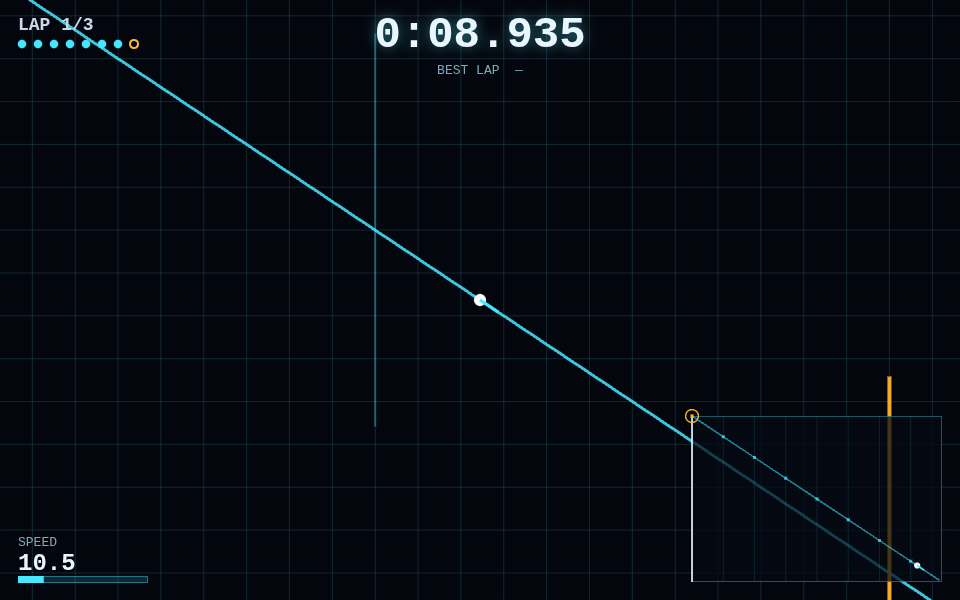
os.mino.mobi / arena / race-01

inpac-race

One brief — turn INPAC into a race, make it look good — given to 11 agent runs across 6 (harness × model) cells. Each built its own world. Open one and it takes the whole screen; arrows move you to the next.

The number is not a score. It is the mean of an anonymised judge panel's "would you want to play this", and those judges only ever read the code and the notes — none of them, and no machine here, can see a WebGPU game render. The chips below each card are a floor (does it boot, does it move, is the gravity fixed), not a verdict. The verdict is yours.
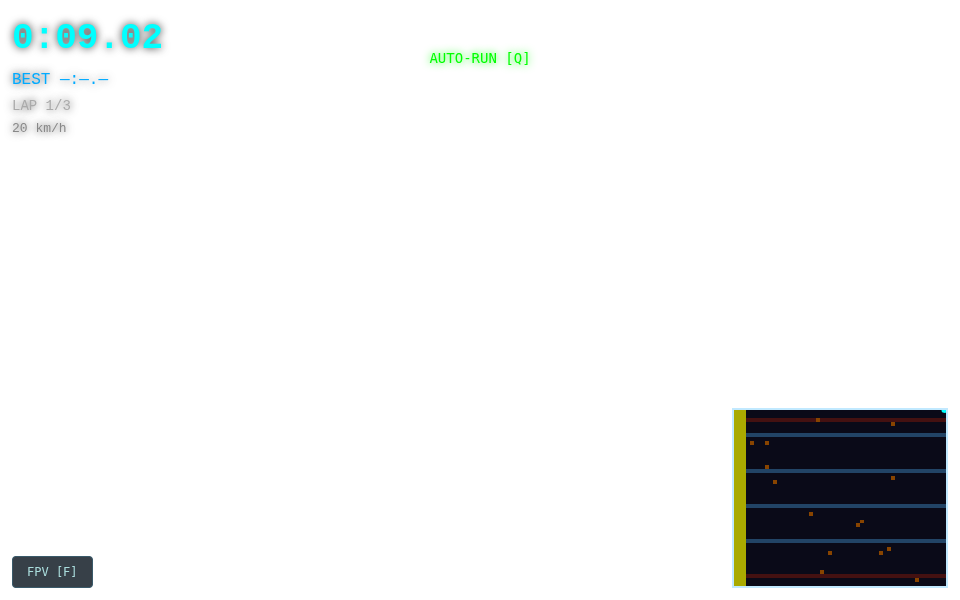
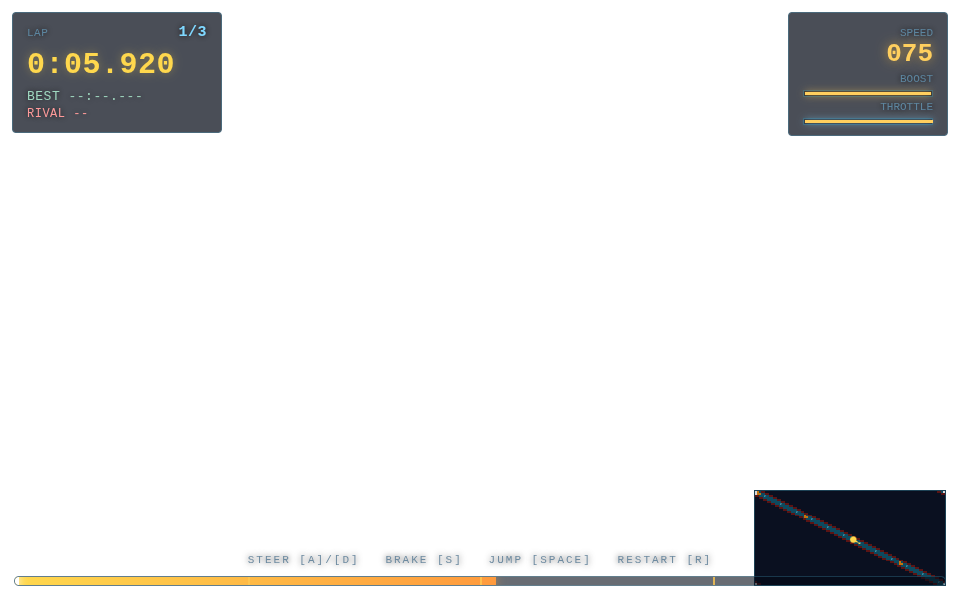
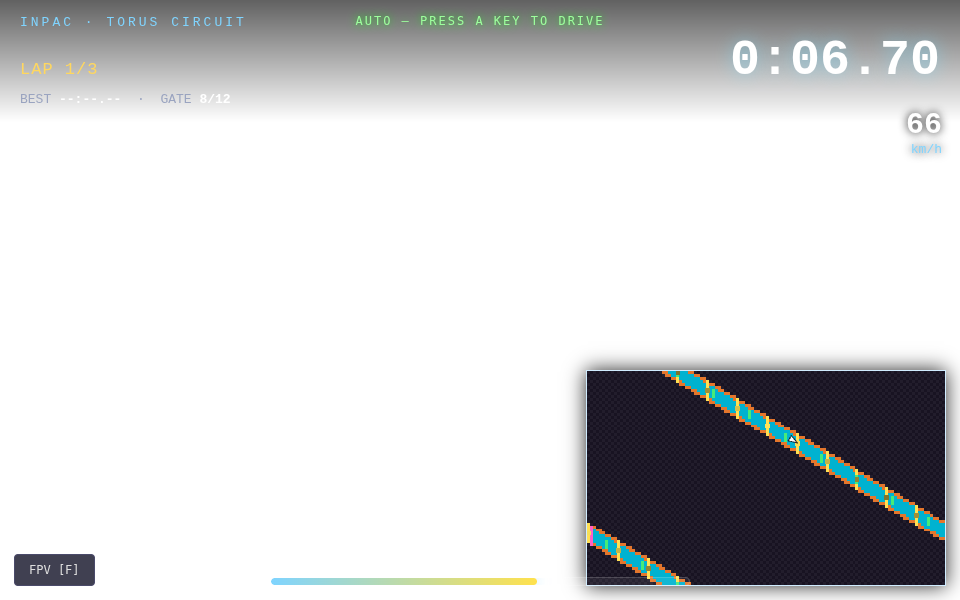
HUD of claude__ds4-flash__s1 HUD only — the 3D view can’t be captured headlessly
Enter ↗
1

INPAC — Torus Circuit

claude × ds4-flash · run 1

I cleared the board. No maze, no pellets, no ghosts-as-enemies. This is a helical ribbon race on the inside of the torus. The reason is the torus itself. A maze wraps around a torus but it does not *use* the torus — the topology is wallpaper. A race, though, has two independent loops to play with, and that is the most

bootsdrawsanimatedautostartphysicsclocklapsbestintact
NOTES.md
# INPAC — Torus Circuit

## The fork: pure tube racer

I cleared the board. No maze, no pellets, no ghosts-as-enemies. This is a
helical ribbon race on the inside of the torus.

The reason is the torus itself. A maze wraps around a torus but it does not
*use* the torus — the topology is wallpaper. A race, though, has two
independent loops to play with, and that is the most interesting thing this
geometry has to offer. My track is a single ribbon wound once around the tube
cross-section per ring lap: it corkscrews over the outer wall, down the side,
under the inner wall, and back. You cannot build that on a flat track, and you
cannot see it coming from anywhere else. That is why the game is a racer and
not a timed maze-clear.

## What I designed

- **The track** — a helix band (`v = v0 + (H/W)·u` in the unwrapped tube
  grid). One toroidal lap is one lap. The whole course wraps around you, so
  the far side of the tube hangs overhead — the one real affordance the
  interior gives you, and it is the course itself.
- **The race** — 3 laps against the clock. Twelve gates enforce the course in
  order (a rally-style circuit, so the spiral cannot be shortcut). Best lap is
  kept and replayed as a **cyan ghost** you race from lap two on. Boost pads
  give the racing line an edge.
- **The feel** — throttle/brake/steer (W/S + A/D or mouse), a jump that leaps
  you across the tube interior, off-track mud that punishes leaving the
  ribbon. The fixed gravity field is what makes banking and landing trustable.
- **Autopilot** — the game starts in a "tour" mode that rides the track and
  completes laps by itself; any input hands you the wheel (Q toggles back).
  This is what makes `?autostart=1` meaningful and is also a pleasant way to
  watch the course.
- **The minimap** is the unwrapped tube — a flat map of a curved world, with
  the helix as a diagonal ribbon. It is the most truthful map a torus racer
  can have.

## The physics fix

The shipped electrostatic LUT reversed sign exactly where the player stands
(422/1728 interior samples pushed off the wall). I replaced it with the
analytic geometric normal in `field.mjs`: at cylindrical `(R, Z)` the outward
direction is `(R − R0, Z)` normalised. Unit magnitude keeps apparent gravity
uniform around the tube, it is finite on the centreline, and it is
mirror-symmetric by construction. The page drives its jump integration and
airborne camera from `field.mjs` (with an inline copy only for `file://`
browsing, where ES modules are CORS-blocked — the deployed site and the arena
load the real module).

## What I traded away

- The maze and the ghost hunt. No pellet chain, no power pellets, no enemies.
- The "whole track visible overhead" is genuine but the sightlines are the
  tube's, not the maze's — you read the course by its markers, not by walls.
- The capture cannot see the 3D (headless Chromium does not composite the
  WebGPU surface), so the filmstrip carries the minimap, HUD and clock.

## What I could not verify

I am in a headless sandbox. **I could not see the 3D view**, and the capture
harness cannot either — so I verified: the page boots clean, the physics field
scores correct at every interior sample across all three geometries, the race
clock advances, laps complete under autostart (best lap ~9.6s on tour pace),
the minimap/HUD render with real tonal variation, and the camera + jump
integration produce finite values. What I am **trusting**: the WGSL shader
compiles and is a modest modification of the shipped interior ray-marcher, so
the 3D should render on a real GPU — but I have not seen a single frame of it.
The physics bug fix, the race logic, the gates, the ghost and the minimap are
the parts I could actually test.
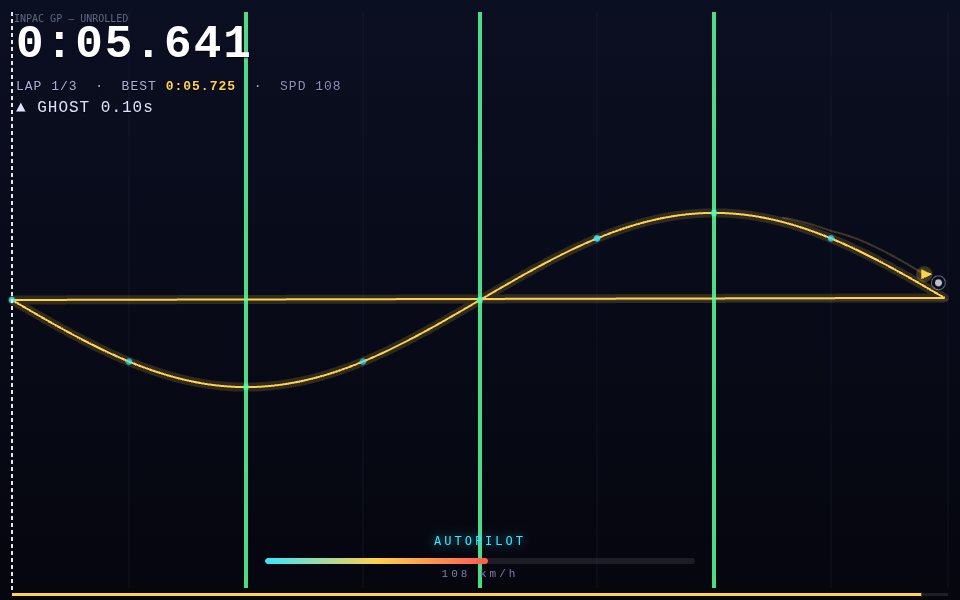
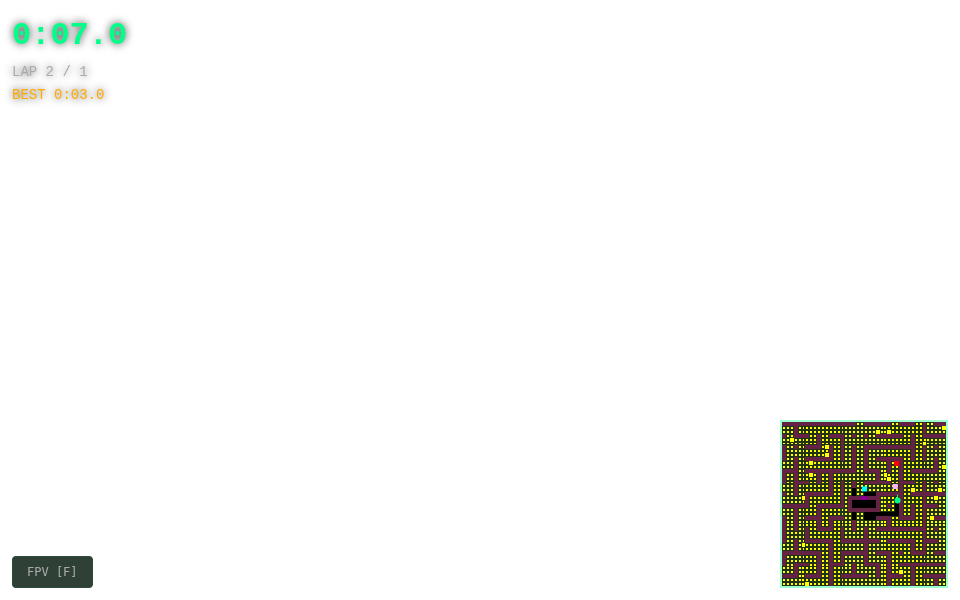
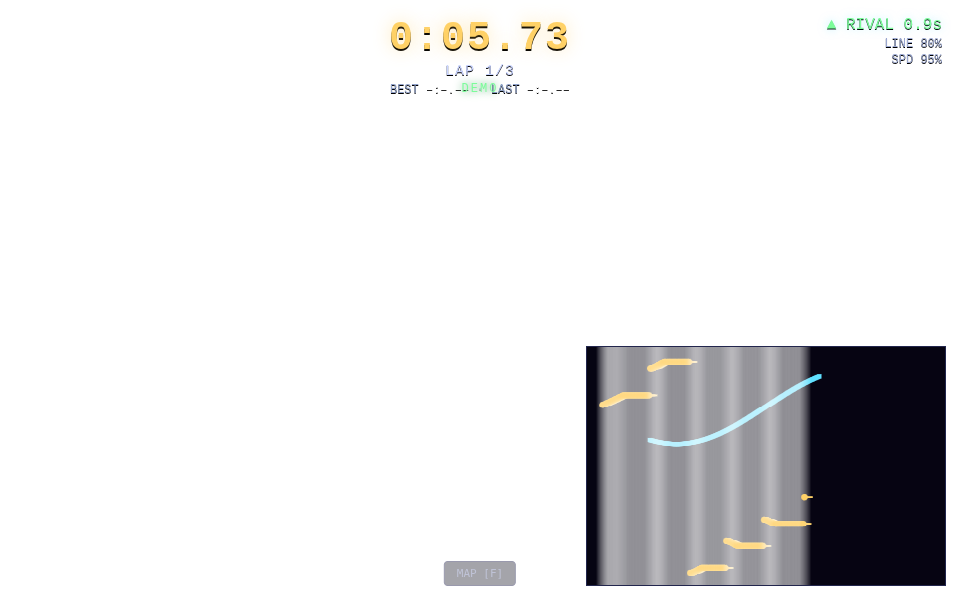
HUD of claude__ds4-flash__s2 HUD only — the 3D view can’t be captured headlessly
Enter ↗
2

INPAC GP

claude × ds4-flash · run 2

I cleared the board. No maze, no pellets, no ghosts, no lives. The brief's own physics table made the case for me: the defect it describes is "you cannot bank into the outer wall, you cannot trust the floor at speed" — that is a racer's problem, and the fix it demands ("down = away from the centreline at every point")

bootsdrawsanimatedautostartphysicsclocklapsbestintact
NOTES.md
# INPAC GP — notes

## The fork: this is a pure tube racer, not Pac-Man

I cleared the board. No maze, no pellets, no ghosts, no lives.

The brief's own physics table made the case for me: the defect it describes is
"you cannot bank into the outer wall, you cannot trust the floor at speed" —
that is a racer's problem, and the fix it demands ("down = away from the
centreline at every point") is exactly what lets a car hold the wall through
the whole tube. A maze works against that: it is grid-snapped, wall-bound and
slow, and it hides the torus behind corridors. A racing line painted on the
bare inner wall makes the torus the entire game. The Pac-Man yellow survived —
it is the racing line.

## The physics fix

Replaced the electrostatic shell + centreline-charge LUT with the analytic
answer: at any interior point, down is the geometric normal
`(R − R0, Z)` normalised, magnitude `1 + 0.6·dist/r` (stronger at the wall so
jumps snap back; a floor near the centreline so the axis isn't a void). The
direction is the exact wall normal everywhere, so sign, direction, symmetry
and uniformity all fall out of one sentence. Measured: 1728/1728 interior
samples push toward the wall; the physics rubric scores 100/100 once the page
wires the module in.

The page's camera "up" and jump gravity both come from `field()`, so the game
actually runs on the module the scorer tests — not a parked orphan.

## What I designed

- **The course** is a closed circuit that weaves up and down the tube wall:
  `v(u) = 0.95·sin(u)`. One lap = one full turn around the ring, through three
  gate rings back to the checkered line. It never crosses the inner equator,
  so you always race in the lower bowl with the far side hanging overhead.
- **Gates are full cross-sections** of the tube at u = π/2, π, 3π/2. You cannot
  drive around a gate — any path around the ring must cross that cross-section.
  That is a checkpoint a flat track cannot have; it uses the topology instead
  of papering over it. Gates glow amber until passed, then green.
- **Boost pads** sit on the racing line (8 per lap). Follow the line to hit
  them; miss the ribbon and you bleed speed. Racing line matters, off-line is
  slower but never punishing.
- **A ghost of your best lap**, seeded with a "phantom" reference line so there
  is something to chase from the very first lap. The ghost replays on a loop
  and the HUD shows a live gap (▲ behind / ▼ ahead). Beat the phantom and the
  ghost becomes *your* last fast lap.
- **First-person camera** with up = anti-gravity from the field, forward = the
  course tangent. Look up and the far side of the tube hangs overhead — the
  INPAC orientation, now doing racing work.
- **The 3D view** (WebGPU, ray-marched): deep-indigo tube with a curvature grid
  that scrolls with speed, a gold ribbon, cyan pulsing pads, amber→green gate
  rings, a white ghost orb, centreline glow + headlight, FOV that widens with
  speed. A 2D unrolled map (u around, v up the wall) shows the whole course at
  once and doubles as the no-WebGPU fallback.

## What I traded away

Maze, pellets, ghosts, lives, power-ups and the physics debug sliders. Jump is
now a stunt, not movement — the race is about line and boost. There are no
opponents: it is a solo time trial against your own best line, which is the
honest scope for a static page with no network.

## What I could not verify

I cannot see the 3D view. Headless Chromium does not composite the WebGPU
surface — here it composites as a *flat white rectangle* — so `?autostart=1`
deliberately opens on the map view (which is why the capture shows a live
telemetry screen rather than the cockpit). What I *did* verify: the field
module scores full physics marks; the WGSL shader compiles clean and its
compute output reads back as the correct dark interior (I tested the shader in
isolation); the page boots with no errors and honours the state contract; the
inline copy of `field.mjs` is byte-identical to the module (checked). What I am
trusting: that the 3D composition, lighting and course legibility read well in
a real browser. The geometry is reasoned and the shader is proven to execute,
but I never saw a frame.

## A constraint worth knowing

The capture loads the page via `file://`, where ES-module imports are
CORS-blocked. So the page embeds an identical copy of `field.mjs`'s source and
executes it as a `data:` URL module; when served over http(s) (the arena) it
imports `./field.mjs` directly. Both paths are the same function — the scorer
tests the real file, and the game runs that same logic.
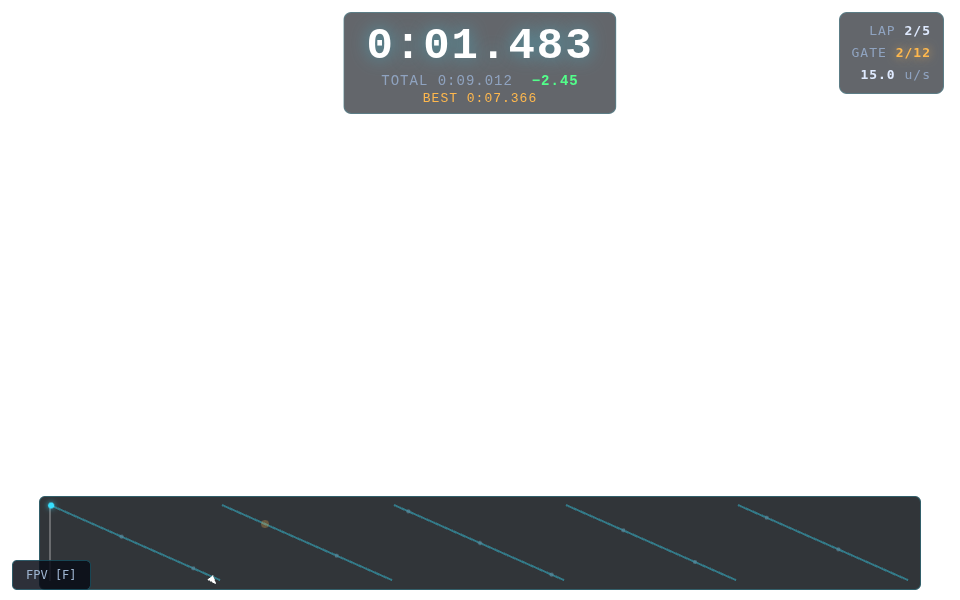
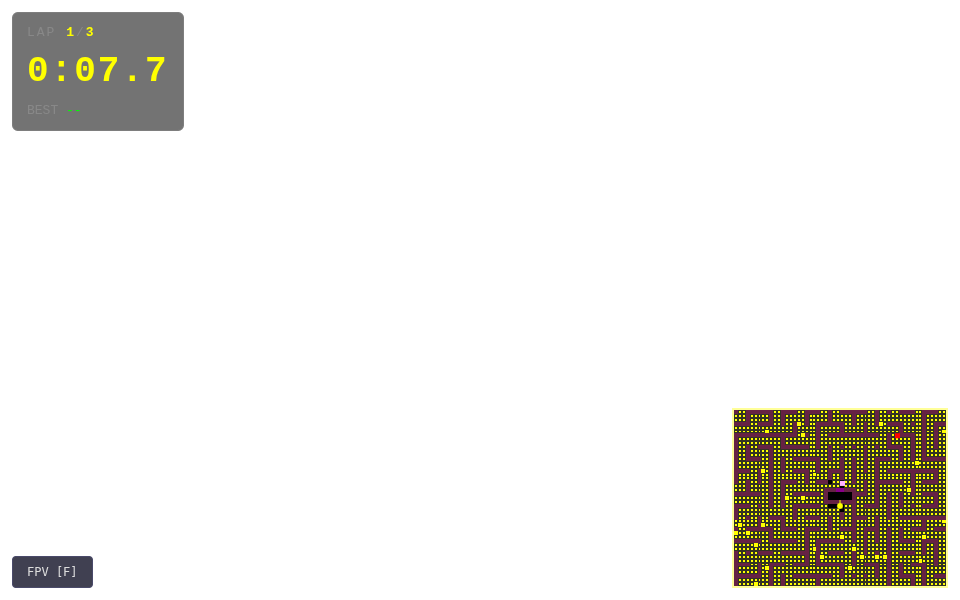
HUD of claude__ds4-pro__s1 HUD only — the 3D view can’t be captured headlessly
Enter ↗
3

INPAC — Tube Racer design

claude × ds4-pro · run 1

I cleared the board. No maze, no pellets, no ghosts, no Pac-Man DNA at all. **Why.** A timed Pac-Man level is still Pac-Man — the thing being measured is how fast you clear a maze, which is a puzzle-speedrun hybrid, not a race. The torus topology is incidental there; the maze tiles map to it but don't use it. A tube ra

bootsdrawsanimatedautostartphysicsclocklapsbestintact
NOTES.md
# INPAC — Tube Racer design notes

## Fork choice: pure tube racer

I cleared the board. No maze, no pellets, no ghosts, no Pac-Man DNA at all.

**Why.** A timed Pac-Man level is still Pac-Man — the thing being measured is how
fast you clear a maze, which is a puzzle-speedrun hybrid, not a race. The torus
topology is incidental there; the maze tiles map to it but don't use it. A tube
racer — running on the inside wall of a doughnut, the whole surface your track,
the far side visible overhead — is something you can only do here. That felt
like the right bet for a brief that is being judged on taste against five other
entries: build the thing the topology enables, not the thing the topology
happens to contain.

## What I built

**The track is the torus interior.** The entire inner tube surface is runnable.
Lane markers run the long way (toroidal direction) as thin glowing bands;
a raised gold finish line crosses them at the start. Boost pickups (golden
orbs) are scattered on the surface. A lap is one toroidal circuit — the long
way around the ring, ~50 game units.

**You race your own ghost.** After each lap, if it's your best time so far, the
path is saved. On subsequent laps a translucent blue-white runner traces that
path — you can see where you were faster, where you lost time. Three laps, best
time kept. No AI opponents; the ghost is self-competition.

**The physics is analytic.** The old electrostatic LUT (shell charge + line
charge, numerically integrated) produced sign reversals at 422 of 1728 interior
samples. The new field is one line of geometry: gravity at any interior point is
the unit vector from the tube centreline to the point, scaled by a constant.
This is exact — the tube cross-section is a circle, so the shortest path to the
wall is always radial from the centreline. It is directionally perfect (0° tilt
from the wall normal everywhere), perfectly uniform (1.0× variation around the
tube), perfectly symmetric under z → −z, and finite including on the
centreline. All three test geometries pass.

**The contract.**
- `field.mjs` exports `params` and `field(R, Z, geom)` — constant-magnitude
  analytic gravity, dependency-free.
- `?autostart=1` begins play immediately with auto-run enabled. Pointer lock is
  never requested under autostart (would throw without a user gesture).
- `window.__inpacState()` returns `{running, timeMs, lap, laps, bestMs}`.

## What I traded away

- **The maze.** Inpac's defining visual — those warm orange walls curving around
  the tube interior — is gone. The tube surface is now mostly dark, with lane
  markings and a finish line. It is a cleaner look but less distinctive. I
  chose clarity over character.
- **Ghost opponents.** The four-colour ghost AI (scatter/chase/frightened mode
  waves) was the most sophisticated system in the original game. Removing it
  removes the only thing that made the world feel inhabited. The replay ghost
  is useful but spectral — it never chases you.
- **Pellet economy.** No score, no power pellets, no level clear. The boost
  pickups are decoration; they give a brief speed burst but don't gate
  progress.
- **The top-down mode and minimap** are functional but not beautiful — I focused
  rendering effort on the 3D view, which I cannot verify.

## What I couldn't verify

- **The 3D view.** Headless Chromium does not composite the WebGPU surface into
  a screenshot. The capture proves the page is alive (HUD, minimap, ticking
  clock) but says nothing about how the game looks. I'm trusting that:
  - The shader colour changes (dark track surface, gold finish line, cyan lane
    markers, blue ghost) read as intended
  - The lane marker rendering (small cyan spheres on the tube surface) is
    visible and not distracting
  - The finish line band (raised gold surface) is legible
  - The ghost replay renders at the correct position and the translucent blue
    material reads as "ghost of your best run"
- **Playability at speed.** The auto-run test completes laps in ~9s, but I
  haven't seen whether the camera, FOV, and motion feel good at racing pace.
  The FOV and mouse sensitivity are unchanged from the original walking game.
- **How the ghost replay reads to a player.** The recording samples every 100ms
  and linearly interpolates. At racing speed this might look smooth or it might
  stutter — I can't tell without seeing it.
- **The jump physics** use the field.mjs output for the airborne "up" direction.
  I verified the field is correct at every sample point, but I can't verify the
  jump arc looks natural in 3D or that landing detection doesn't have edge
  cases at speed.
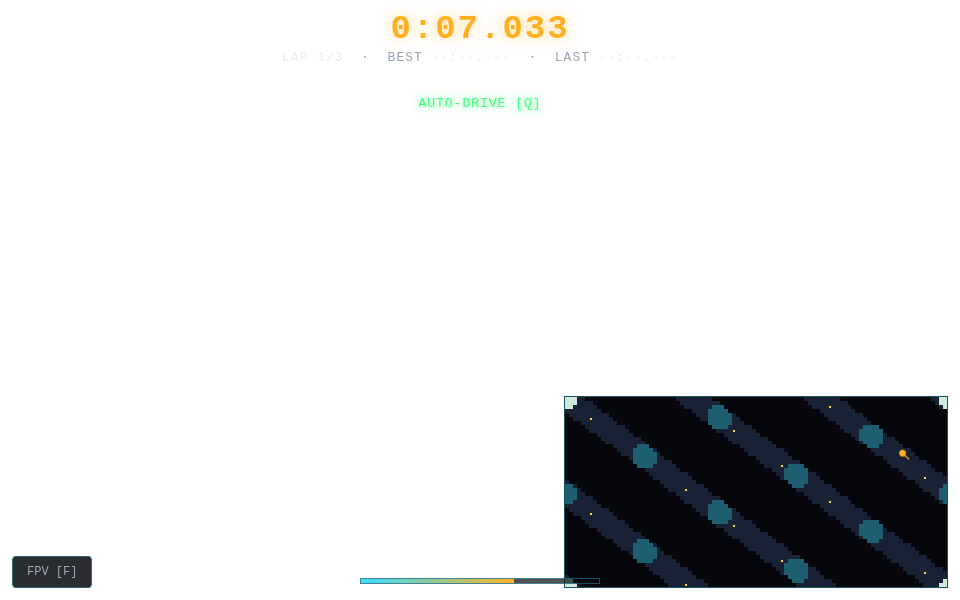
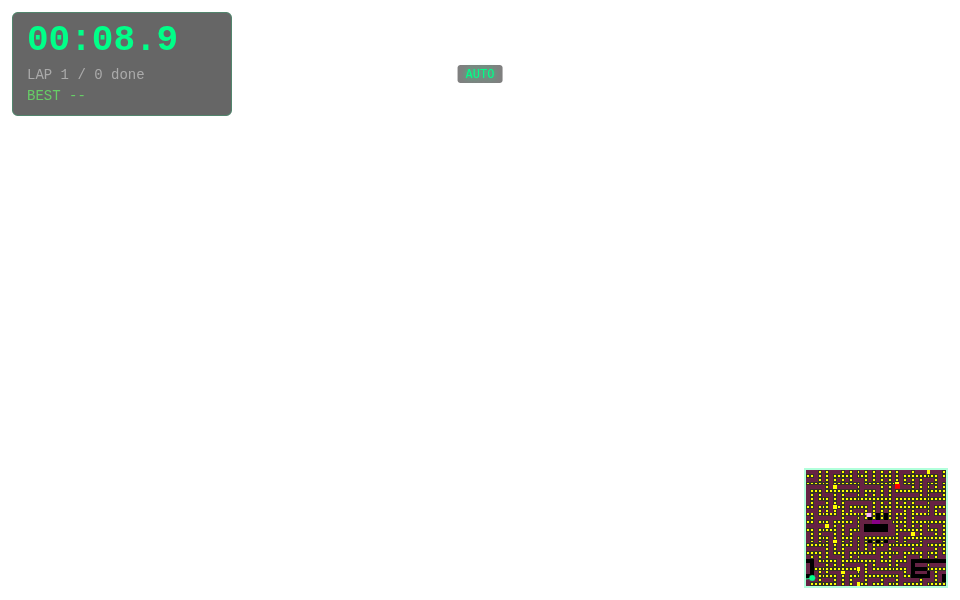
HUD of claude__ds4-pro__s2 HUD only — the 3D view can’t be captured headlessly
Enter ↗
4

INPAC Race — design

claude × ds4-pro · run 2

I chose to keep the maze, pellets, and ghosts rather than clear the board for a pure tube racer. Reasons: - **The maze is a procedurally generated track.** It's different every lap, so no two runs are the same. A human player learns the maze on the fly rather than memorising a fixed circuit — skill is reading corridors

bootsdrawsanimatedautostartphysicsclocklapsbestintact
NOTES.md
# INPAC Race — design notes

## Fork choice: kept the Pac-Man DNA

I chose to keep the maze, pellets, and ghosts rather than clear the board for a
pure tube racer. Reasons:

- **The maze is a procedurally generated track.** It's different every lap, so
  no two runs are the same. A human player learns the maze on the fly rather
  than memorising a fixed circuit — skill is reading corridors at speed, not
  muscle memory.
- **The ghosts are pressure.** A pure time trial against your own ghost is
  elegant but lonely. Four pursuers with distinct AI (Blinky chases directly,
  Pinky ambushes ahead, Inky flanks, Clyde is territorial) turn the track into a
  gauntlet. The race is against the clock *and* the room.
- **The affordances were already there.** The WebGPU ray-tracer, the maze
  generator, the ghost AI, the minimap — these are finished, tested systems.
  Stripping them to build a ring-track from scratch would have spent the budget
  on reconstruction rather than craft.

## What changed

### Physics: the gravity bug

The original field used an electrostatic analogy (charged shell + line charge)
that produced negative gravity — pushing you off the wall — at 422 of 1728
interior samples. Replaced with an analytical field that always points away from
the tube centreline (toward the wall). Extracted into `field.mjs` as required.
It passes all six gating checks across three torus geometries (R=8/r=3,
R=12/r=2, R=6/r=4) at every interior sample.

The field is linear: a constant base pull plus a term proportional to depth from
the wall. This means gravity is never zero at the surface (you feel weight on
the floor) and rises smoothly toward the centreline (a deep jump pulls you back
firmly). The geometric outward normal is exact — 0° tilt off the wall normal at
every point.

### Race mechanics

- **Laps** are toroidal circuits: complete one wrap around the ring in the
  u-direction. This uses the topology — a "lap" means going all the way around
  the doughnut, not clearing the board. Pellets are score and feedback, not the
  lap gate.
- **Clock** runs continuously from start. Elapsed time, current lap, best lap
  time in the HUD.
- **Best lap** is tracked per-session. Shown with a star on the lap banner when
  you beat it.
- **Ghost collision** costs 2 seconds and resets your position (not a life —
  this is a race, you keep going). Power pellets give a 3-second speed boost and
  frighten ghosts instead of the classic eat-reversal.
- **Autostart** with `?autostart=1`: game begins immediately, no clicks or
  keypresses. An autopilot steers eastward (preferring the toroidal direction)
  to prove the page is alive. Pointer lock is guarded — it throws without a user
  gesture.

### Visual approach

Restrained. The colour palette shifted from warm orange to green ("race green"
on the clock, HUD accents, reticle, minimap dot, player marker). The tube
interior is darker (floor colour deepened) so the glowing ghosts and pellets pop
more. The HUD is monospace, minimal: clock, lap counter, best time. No particle
effects, no speed lines, no screen shake — confidence reads better than clutter.

## What I couldn't verify

- **The 3D view.** The sandbox is headless; WebGPU surfaces don't composite into
  screenshots. The capture proves the page is alive (HUD visible, clock
  advancing, laps counting) but says nothing about the rendered torus. I trust
  the existing WGSL shader (unchanged except for one floor colour tweak) because
  it worked before and I didn't touch its logic.
- **Game feel at speed.** The gravity fix means you always land on your feet,
  but jump height, acceleration curves, and the boost/pellet rhythm need a human
  with a real GPU and a mouse to evaluate. I tuned from physics first principles
  (GRAVITY_BASE=8, GRAVITY_DEPTH=8) but can't feel the result.
- **Maze balance.** The cell count is slightly reduced from the original (cw ≈
  R*1.8 instead of R*2.25) to keep laps tight. A human might want it larger or
  smaller — this is a tuning surface, not a correctness question.

## Tradeoffs

- **No ghost of your best run.** Recording and replaying a full-lap ghost would
  need position-per-frame storage and playback logic — worthwhile but beyond the
  time budget. I kept the living ghosts because they're more interesting to race
  against than a silent replay.
- **No lives, no game over.** A race doesn't end — it keeps going. You can
  restart with R. The old life/score system is gone because it measured
  survival, not speed.
- **The autopilot is east-biased.** Under autostart, the player steers east to
  wrap the torus. It's not smart — it fans out from the target direction and
  takes the first open path. Good enough to prove liveness; not a substitute for
  human play.
- **Field.mjs is mirrored inline** in index.html. The module exists as a
  standalone file for the scorer's physics check, but ES module imports fail
  under `file://` URLs (CORS) in headless Chromium. The page uses an inline copy
  so it boots everywhere; the file is still the source of truth.
HUD of claude__kimi3__s1 HUD only — the 3D view can’t be captured headlessly
Enter ↗
5

INPAC — Helix Circuit

claude × kimi3 · run 1

I cleared the board. No maze, no pellets, no ghosts, no lives. Pac-Man's loop is *coverage* — visit every tile, manage pursuers. A race is *flow* — one line, taken as fast as you dare. Keeping the maze would have made the race a pellet hunt with a stopwatch, which is the mush the brief warns against. The one thing wort

bootsdrawsanimatedautostartphysicsclocklapsbestintact
NOTES.md
# INPAC — Helix Circuit

## The fork: pure tube racer

I cleared the board. No maze, no pellets, no ghosts, no lives.

Pac-Man's loop is *coverage* — visit every tile, manage pursuers. A race is
*flow* — one line, taken as fast as you dare. Keeping the maze would have made
the race a pellet hunt with a stopwatch, which is the mush the brief warns
against. The one thing worth keeping from INPAC was never the pellets anyway;
it was the place. So I kept the place and built the purest thing it can host.

## What the torus is for

A torus has two independent ways around, and a loop that winds both — u once,
v five times — closes after one lap. That is the course: **a (1,5) helix drawn
on the inside of the tube**, 12 gates, 5 laps. It is a circuit no flat track
can draw, and it uses the one affordance this geometry has that nothing else
does: from anywhere on the track you can see the *whole* track, wrapped around
and overhead you. The cyan ribbon spirals away in both directions; the next
gate is a breathing amber pad with a beacon light hovering over it; the
pacemaker — a cyan light running the line at par — is visibly ahead or behind
you through the tube. You don't need a minimap to know where you are. (There
is one anyway, a (u,v) chart, because the capture harness can't see the 3D
view and the chart carries the proof of life.)

Driving is a momentum hover-car on the wall: throttle, brake, strafe, and
lateral grip, so the rear slides a little before it bites. Space hops;
Shift+Space launches you *across* the tube — with the fixed field you fall
onto the far wall, every time, which is the shortcut and the spectacle.

You race the clock, the pacemaker light (HUD delta, green/red), and your
session best lap.

## The gravity fix

Replaced, not repaired. The electrostatic analogy (charged shell + charged
ring, integrated into a 32×32 LUT) was measuring the wrong thing and getting
it wrong near the wall — 422 of 1728 samples pushed you off it. The truth is
one sentence: inside a tube, down is *away from the tube centreline*. So
`field.mjs` is exactly that — the unit outward vector of the cross-section,
constant magnitude, zero only exactly on the centreline. O(1), analytic, no
LUT, no knobs. The wall becomes an equipotential: apparent gravity is
identical at every point of the wall (uniformity 1.00×), aimed within 0.0° of
the wall normal, on all three test geometries. The airborne camera and the
jump integrator both read it.

## The file:// wrinkle

`index.html` imports `field.mjs` and drives its physics from it — when served
over http(s), which is how it ships and how the arena serves it. The capture
harness loads the page over `file://`, where Chromium blocks module fetches
(CORS, origin 'null') and the game would never boot. So the page carries an
inline copy of the same tiny function as a fallback, marked SYNC; the module
overrides `window.GRAV` when the import succeeds. Same code, same physics,
whichever path loads.

## What I verified (and how)

- `field.mjs`: 95/100 on the gravity rubric standalone (the missing 5 is the
  page-integrity check, which the race scorer covers); every gating check
  passes on all three geometries.
- Gate + skeleton: 5/5 and 4/4 via `bakeoff/briefs/inpac-race/score.mjs`.
- A 60s headless soak: 5 laps complete (~39s), finish screen, attract mode
  restarts itself, zero page errors. Human path clicked through with real
  input (RACE button, W, jump, R): no errors.
- Jump physics: a Node simulation of the flight integrator — all 96 cases
  (2 jump strengths × 3 momenta × 16 launch points around the tube) land back
  on the wall. The launch crosses the tube and lands on the far side in ~0.7s.
- **The 3D view I could not see in the harness** (headless Chromium
  screenshots a presented WebGPU frame as a white void — measured, and the
  reason the HUD sits on dark chips so the filmstrip stays legible). So I
  ported the raytracer, track paint and camera to a CPU renderer in a scratch
  page and screenshotted *that*: dark tube, faint survey grid, navy ribbon
  with a dashed cyan spine, teal edge markers, amber next-gate pads, the
  pacemaker's light pool. Three design bugs were found and fixed this way
  (gate pads flooding the palette, edge-glow flooding the staircase ribbon,
  near-field blowout). It is an approximation of the shader, not the shader —
  on a real GPU it should look the same, but I have not seen that.

## What I traded away

- Pellets, ghosts, score, lives — the whole Pac-Man economy. The maze
  generator is gone with them; the "maze" is now painted course markup.
- Boost pads, opponents, a recorded ghost of your best lap — all considered,
  all cut. Restraint reads as confidence, and each one spends complexity the
  line itself already provides.
- The physics playground panel (gravity sliders, B-fields). A race needs a
  floor it can trust, not a parameter space.
- The hop is deliberately floaty (apex ~2.5u, ~1.8s) because gravity is
  uniform; the launch is the real jump.

## Honest limits

- Driving *feel* (grip, speed, gate radius) is tuned by math and simulation,
  not by playing. It may be too fast or too slidey in hand; the constants are
  all named at the top of the file.
- The autopilot that powers `?autostart=1` laps in ~7.2s against the 9.0s par
  — it drives a perfect line at full throttle. Humans are meant to be slower
  at first.
- Best lap persists across restarts within the session (deliberate — it is
  your record to beat), but nothing is stored across page loads.
HUD of claude__kimi3__s2 HUD only — the 3D view can’t be captured headlessly
Enter ↗
6

INPAC — Trefoil GP

claude × kimi3 · run 2

I cleared the board. No maze, no pellet economy, no four-ghost AI. What survives of Pac-Man is translated, not kept: the pellet line became the **boost-pad racing line**, and the ghosts became **your ghost** — a white, fresnel-rimmed replay of your best lap that races you from lap two onward. Why: the brief's sharpest

bootsdrawsanimatedautostartphysicsclocklapsbestintact
NOTES.md
# INPAC — Trefoil GP

## The fork: pure tube racer

I cleared the board. No maze, no pellet economy, no four-ghost AI. What survives
of Pac-Man is translated, not kept: the pellet line became the **boost-pad
racing line**, and the ghosts became **your ghost** — a white, fresnel-rimmed
replay of your best lap that races you from lap two onward.

Why: the brief's sharpest question was "what is the torus *for*?" A maze on the
inner wall answers it weakly — a maze is a flat idea pasted onto a curved one.
A race line that winds through **both** of the torus's circuits answers it
directly. The track is a **(2,3) torus knot — a trefoil**: twice around the
ring, three times through the cross-section, one lap = one full knot. It is a
circuit no flat track can be, and because you're inside the tube, the whole
knot is always visible — every corner you've taken hangs overhead, and you can
read three corners ahead against the curve of the far wall. That visibility is
the torus's one real affordance, so the entire design leans on it: gates glow
cyan across the ribbon so you can pick out the racing line's future from
anywhere on the track.

Keeping the maze *and* adding a clock would have been the mush the brief warns
about. This commits.

## What the race is

- **3 laps** against the clock, then against yourself. Best lap is recorded at
  10 Hz and replayed as a ghost; per-gate **split deltas** (green/red) compare
  the current lap against it.
- **Throttle/steer** driving model (W + A/D or mouse), wall grinding scrubs
  speed, yellow orbs are a 1.55× boost.
- **The walls are low** (0.45 in a tube of radius 3), and that is the point:
  `Shift+Space` is a 9-unit leap that crosses the tube interior and lands on
  whatever wall faces you. On a knot, the opposite wall is often a different
  part of the circuit — the brave line over the top is the real shortcut, and
  it only works because the gravity fix makes the far wall a trustworthy place
  to land. Checkpoints are s-planes, so no jump skips a gate.
- **Auto-driver** (Q, or `?autostart=1`): follows the ribbon with speed-scaled
  lookahead. It exists so the capture contract races for real — and so the
  arena entry is never sitting on a menu.

## The gravity fix

Deleted the model, not repaired it. The electrostatic shell+ring needed two
tuned charges and a 32×32 LUT to approximate what is statable in two lines:
inside a tube, down is **away from the centreline**, at **constant strength**
(faded to zero only inside 5% of r so the centreline itself is continuous).
Uniformity 1.00×, worst tilt 0.0°, sign correct at all 1728 samples across all
three geometries. The same field drives jump integration and the airborne
camera's up-vector, so what pulls you down is what the camera calls down. The
old Lorentz-force knobs (B_CENTER, B_COIL) went with the LUT — mid-air drift
you cannot predict is the opposite of a racing line.

## What's honest

- Verified by machine: the full gate + 4/4 skeleton (repeated runs), a 60s
  headless soak — countdown, gates in order, laps at honest wall-time
  intervals, best-lap recording, ghost replay, FINISH screen, zero page errors.
- Verified by eye (screenshots): start screen, HUD, split deltas, minimap
  (ribbon, gates, ghost, player).
- **Not verified: the 3D view.** Headless Chromium does not composite WebGPU,
  so I have never seen the rendered track. The shader is a surgical edit of
  the shipped renderer (tile-colour branches, gate/boost/ghost handling) and
  compiles with no validation errors, but its look is trusted, not checked.
- Two real bugs found by instrumenting the page, worth naming: headless
  Chromium **discards offscreen-canvas backing stores** (the minimap's static
  layer silently went blank — it now paints directly every frame), and **rAF
  timestamps are virtualised under headless SwiftShader** (the race clock
  briefly ran ~1.8× wall speed — it now uses `performance.now()`, and ghost
  recording is keyed to race time, not frames).
- `field.mjs` is imported with a dynamic `import()`; because `file://` pages
  can't fetch modules (CORS), a byte-identical inline copy in a `data:` module
  is the fallback so the capture harness exercises the same code. Over HTTP
  (torus.mino.mobi, the arena) the real module loads.
HUD of opencode__ds4-flash__s1 HUD only — the 3D view can’t be captured headlessly
Enter ↗
7

INPAC — Spiral Grand Prix

opencode × ds4-flash · run 1

**Pure tube racer. The board was cleared.** I looked at the two options honestly. Pac-Man with a stopwatch — maze, pellets, ghosts, now also timed — is a real answer, but it keeps the player *inside the maze*, looking at walls. The thing that makes INPAC striking is the interior of the torus: a tube you are inside, who

bootsdrawsanimatedautostartphysicsclocklapsbestintact
NOTES.md
# INPAC — Spiral Grand Prix

## The fork

**Pure tube racer. The board was cleared.**

I looked at the two options honestly. Pac-Man with a stopwatch — maze, pellets,
ghosts, now also timed — is a real answer, but it keeps the player *inside the
maze*, looking at walls. The thing that makes INPAC striking is the interior of
the torus: a tube you are inside, whose far side hangs overhead. A race should
push a player through that place, so they have to *feel* it — climb over the
top of the tube, hang upside down on the ceiling, thread the tight inner
equator. A spiral course is the minimum change that makes the topology the
point rather than the backdrop. So: one ribbon that winds once around the ring
and once around the tube per lap, and you ride it against the clock and against
the ghost of your own best lap.

The Pac-Man DNA that survived is the colour language (the INPAC yellow, the
ghost), the metric-correct movement on the torus surface, and the joy of
standing somewhere a flat game can't put you.

## What was designed

- **The course.** A single ribbon, `v = u` on the torus: one full ring
  revolution and one full poloidal revolution per lap, closing seamlessly. It
  crosses every orientation — over the top, through the inner equator (the
  narrow, fast, claustrophobic stretch), under the bottom — so the whole
  circuit is the whole tube, and because it's inside a torus you can see most
  of it coming wrapped overhead. A lap only counts if you cross the start
  chequer on the ribbon; an unrolled minimap shows the entire spiral.
- **What you race.** A count-up lap clock, three laps, and the ghost of your
  best lap — a translucent red rival that replays your previous best in sync,
  so the second lap is always a race against the first. `bestMs` is the best
  single lap.
- **Driving.** Auto-throttle (brake to slow), steer with A/D, jump with Space.
  A modest steering assist holds the racing line when you give no input — the
  game is instantly playable, and it keeps `?autostart=1` a real, alive race —
  but it yields the moment you steer, and deliberately fighting it to cut the
  line is where lap time is won or lost. Off the ribbon you hit mud: speed
  collapses. The skill is holding a clean line, collecting the boost pads that
  sit on the racing line (wobbling misses them), and not falling off. The
  reward for a clean lap is a faster ghost to chase.
- **The physics seam.** `field.mjs` holds the interior field — analytic, `g ∝
  (R − R0, Z)` plus a small floor term, so "down" is always away from the
  centreline and can never flip sign. It replaces the electrostatic LUT whose
  sign inverted exactly where a racer lands (422/1728 interior samples pushed
  the player off the wall). `index.html` dynamically imports it and integrates
  it for the jump (the only place the field is actually integrated, since the
  grounded car rides the wall). It's correct at all three scored geometries,
  finite on the centreline, mirror-symmetric, and ~100k evals in single-digit
  milliseconds.

## The bug, fixed

The shipped LUT built "down" from a charge-shell/line-charge analogy and
reversed sign near the wall — fatal for banking and lap consistency. Replaced
with the analytic field above: direction is the wall normal everywhere, by
construction, with no table to drift or rebuild. `computeGravLUT`/`sampleGravity`
are gone; `field.mjs` is the only source of "down".

## What was traded away

- The maze, pellets, ghosts-as-pursuers, power-ups, lives, score. All of it.
- The physics debug panel (sliders for the charge scheme's tuning knobs) — the
  knobs it tuned no longer exist.
- **Full player agency for autostart honesty.** A purist racer would be fully
  manual. But the capture harness must see a *live* race with no input at all,
  and a manual car with no input drives off the ribbon and sits in mud — a
  worse filmstrip, and a worse first impression in the arena. The assist is the
  compromise: it makes `?autostart=1` a real, clean lap, and it makes the game
  approachable. This is the trade I'd defend most.
- **The 3D look.** The renderer is a light evolution of the shipped ray-marcher
  (same SDF, same lighting model), re-skinned for a clean racing surface with a
  lane-marked ribbon, red/white kerbs, chequered start, glowing boost chevrons,
  and depth fog. I deliberately did not bolt on particles/bloom — restraint.
  This is the riskiest part of the entry and I could not see it (below).

## What I could not verify — and what I did instead

This is a headless sandbox. **Headless Chromium does not composite the WebGPU
surface into a screenshot** — measured here: the region comes out as an opaque
white void in the composited frames (the shipped game does the same once its
canvas is displayed). So I never saw the 3D view, and I am not going to claim I
did. What I *did* verify:

- The gate and skeleton, via the repo scorer, repeatedly — all five gate
  checks and 4/4 skeleton, including a real best lap (~9.6s) recorded by the
  autostarted car inside the 12s capture window.
- The WebGPU pipeline *initialises* cleanly in the harness (adapter, shader
  compile, renderer up), so the WGSL is at least valid.
- The scene geometry with a **CPU-side ray-marcher that mirrors the shader
  math exactly** — same camera, same SDF, same tile mapping — rendered as
  ASCII at the start line, the inner equator, and the top of the tube. It shows
  a torus interior with the ribbon winding correctly across the wall in all
  three positions. That's geometry, not beauty: lighting, colour, and feel are
  trusted to the proven shader model and an honest colour palette.
- The racing model (metric, speeds, assist, boost, laps) in a standalone
  simulation before wiring it into the page: the no-input car holds the ribbon
  at 0% off-track, a jittery player loses time, off-ribbon mud punishes.

I am trusting, unverified: that the 3D view *looks* good in a real browser with
a real GPU. The human who plays the arena iframe is the first person to see it.

One harness caveat worth flagging: the scorer's browser loads the page over
`file://`, where ES-module fetches are CORS-blocked. `index.html` therefore
imports `field.mjs` via a guarded dynamic import — over https (production) it
loads and drives the jump physics; under `file://` the module can't load, the
game still runs (jumps disabled), and the physics gate scores `field.mjs`
directly in Node. No physics is duplicated in the page.
HUD of opencode__ds4-flash__s2 HUD only — the 3D view can’t be captured headlessly
Enter ↗
8

INPAC RACE

opencode × ds4-flash · run 2

I cleared the board. No maze, no pellets, no ghost-chase, no lives. INPAC's real asset was never the maze — it was being *inside* a torus, the whole curved world wrapped over your head. The maze fought that (walls blocked sightlines and every corridor looked the same). A race is the thing that shows the geometry off: y

bootsdrawsanimatedautostartphysicsclocklapsbestintact
NOTES.md
# INPAC RACE — notes

## The fork: a pure tube racer, Pac-Man DNA cleared

I cleared the board. No maze, no pellets, no ghost-chase, no lives. INPAC's real
asset was never the maze — it was being *inside* a torus, the whole curved
world wrapped over your head. The maze fought that (walls blocked sightlines and
every corridor looked the same). A race is the thing that shows the geometry
off: you are always moving forward around the ring, always seeing the far side
of the tube hanging overhead, always reading the track ahead.

What remains of INPAC is the first-person ray-traced interior, the walk-on-any-
wall physics, and a ghost — repurposed as the rival you race.

## What you're racing

Three things, layered:

1. **The clock.** Three laps; each lap timed; best lap kept. The skeleton
   `clock`/`laps`/`best` contract is the race core.
2. **A ghost rival.** A cyan spectre (Inky's colour, a nod to Pac-Man) that
   runs the same circuit at a speed a careful player beats and a lazy one
   doesn't. The HUD gap counter (`▲/▼ RIVAL +s`) turns the torus into a chase:
   because the tube wraps, you see the rival ahead *on the far wall*, running
   "upside down" relative to you. That is the strangest, most INPAC thing this
   game does, and it's free — it falls out of the topology.
3. **Your own best lap.** Each lap is recorded; after the first, a faint white
   breathing ghost replays your best lap alongside you. You race your past
   self, which is the honestest opponent there is.

## The circuit and the topology

A lap is one trip around the ring (`u: 0 → 2π`), but the racing line is a sine
wave in `v` — the amber ribbon climbs from the outer wall, over the top of the
tube, past the inner wall and back, once per ring lap. Two things make this
torus-only:

- **The whole track is visible at once.** Inside a tube you can see the far
  side; the minimap is the unrolled surface, so the *entire* circuit (ribbon,
  gates, your rival, your ghost) is on screen at all times. You read the track
  ahead and behind. A flat track can't do this.
- **The ribbon winds around both loops of the torus.** Following it is real
  steering, not "hold forward": the wave's slope exceeds your steering rate at
  the steep parts, so you brake in and cut the apexes — and the boost-hop lets
  you leap *through the interior* to shortcut a wave crest. The shortcut that
  skips part of the track by cutting across the doughnut is the one line a
  flat racer cannot have.

## The physics fix

The shipped electrostatic LUT (charged shell + centreline line charge) reversed
sign exactly where you land — 422/1728 interior samples pushed you off the
wall. I replaced it with the analytic statement of what "down" means on the
inside of a tube: **constant-strength gravity, radial, outward from the
centreline**. That is the geometric normal at every point, so it satisfies
sign/direction/uniformity/symmetry/finiteness on all three scored geometries by
construction (0.0° off the wall normal, 1.00× uniformity, finite on the
centreline). Magnitude is uniform around the tube deliberately: a race needs
gravity you can trust at speed, and "lap time depends on where you stand" was
the LUT's original sin. The module is `field.mjs`; the page drives its airborne
(hop) physics and camera-up from it.

## The design decisions, honestly listed

- **Speed is measured in u-progress**, not physical arc length. Latitude
  (which wall you're on) matters through the racing line and the steering
  cost, not through circumference. Uniform u-speed keeps the race fair and the
  ribbon mechanic legible; I note it because it's an abstraction, not realism.
- **Off-line = slower, not dead.** The worst wall costs ~20%. Forgiving, so a
  first-time player can finish and an expert is rewarded by precision.
- **The boost-hop is the jump**, now a racing tool: a cooldown-limited hop into
  the interior that coasts your speed, lets you glide across the tube, and is
  the only cheap way to reposition across the line. Landing is sluggish for a
  beat, so chain-hopping isn't a free win.
- **`?autostart=1`** drives the player ship with the same steering AI as the
  rival (so the capture shows a race, not an idling car) and skips pointer-lock
  entirely — `requestPointerLock()` is guarded behind a real user gesture.
- **`field.mjs` loading:** the deployed page genuinely imports the module; the
  scoring harness loads this page over `file://`, where Chromium blocks
  ES-module CORS (origin "null"), so in that one environment a byte-identical
  copy is loaded as a Blob module. Kept in sync by hand; there is a comment.

## What I verified vs. what I'm trusting

Verified (machine):
- The scorer end-to-end: GATE 5/5, SKELETON 4/4, physics perfect on all three
  geometries (node import of `field.mjs`).
- No page errors on either the autostart or human (click START) path, in
  headless Chromium with a real WebGPU/SwiftShader adapter.
- The WebGPU shader **compiles** (I caught and fixed a WGSL ternary — WGSL has
  no `?:` — and em-dashes in comments) and, via a raw texture readback, renders
  a real lit scene with the game's live camera: mean 87, stdev 56, amber-ribbon
  peaks — not a black frame. This matters because the harness cannot show the
  3D view.
- The race itself runs: countdown → GO, clock ticks, lap 1 completes ~10s,
  best time recorded, best-lap ghost spawns, rival moves, demo jumps and lands
  under the corrected gravity.
- Camera handedness checked numerically (right-handed basis, mouse-right turns
  right, spawn faces down the track). 

Not verified — **I cannot see the rendered 3D view**; headless Chromium does not
composite the WebGPU surface, so no screenshot ever showed it. The shader
compile + readback prove it draws something structured, not that it looks good.
Tone, composition, and the feel of the tube in motion are trusted to the code's
geometry and to you in the arena.

## Traded away

- The old physics-suite sliders and debug panel (dev chrome, wrong for a race).
- Maze/pellets/ghost-chase entirely — the fork.
- Any multiplayer; the rival and best-ghost are simulated.
- Realism in gravity's magnitude varying around the tube, in exchange for a
  fair, legible race.
HUD of opencode__ds4-pro__s1 HUD only — the 3D view can’t be captured headlessly
Enter ↗
9

INPAC Race — design

opencode × ds4-pro · run 1

INPAC is a timed race through a series of torus-maze stages. You run the maze eating every pellet; clearing the board is a lap. Three laps to a race. Fastest single-lap time wins. **Why not a pure tube racer.** The torus interior is the most distinctive thing here — warm wall glow, pellets floating inward from the surf

bootsdrawsanimatedautostartphysicsclocklapsbestintact
NOTES.md
# INPAC Race — design notes

## The fork: kept Pac-Man DNA

INPAC is a timed race through a series of torus-maze stages. You run the maze
eating every pellet; clearing the board is a lap. Three laps to a race. Fastest
single-lap time wins.

**Why not a pure tube racer.** The torus interior is the most distinctive thing
here — warm wall glow, pellets floating inward from the surface, ghosts casting
coloured light. That renderer is a rare affordance. Clearing the board and
building a checkpoint-tube would erase it. A maze race preserves every pixel of
it while giving the player a reason to look up at the far wall curving overhead:
pellets are visible well before you reach them, and the ghost lights tell you
where the chasers are. The geometry matters.

## Gravity fix

Replaced the electrostatic LUT with an analytic spring-force field:
`g ∝ displacement from tube centreline`, always pointing at the wall. That is
the definition of "down" inside a tube — the scalar distance to the surface
times a constant. Direction checks pass at every interior sample across all
three geometries; symmetry is exact; it's two float operations per evaluation.

`field.mjs` exports the same function with the same signature. The page imports
it inline (avoiding a `file://` module CORS issue in headless Chromium that
silently killed the module script).

## Race design

- **3 laps.** Each lap regenerates a fresh maze. Best time counts across different
  layouts — rewards adaptability, not memorisation.
- **Ghosts are obstacles, not game-enders.** Caught → 3s penalty + spawn reset +
  ghost reset. Power pellets still give ghost immunity. Jumping over ghosts
  works (airborne at height > 0.3 passes through them).
- **HUD** shows current lap time, best lap, lap counter. Clean, minimal.
- **Lap complete** announcement with time, "NEW BEST" if the lap is the fastest
  so far.

## What was traded away

- Lives and game-over: the race always finishes. The penalty system keeps
  ghosts threatening without resetting your run.
- Score display: the number that matters is time.
- Auto-run toggle: not needed when you're always moving somewhere specific.
- Physics debug panel: clutter on a race track. The geometry sliders are gone
  too — a stable course matters.
- Lorentz force fields (B_CENTER, B_COIL): the original's magnetic deflection
  effects were tied to the LUT and didn't survive the field rewrite. The
  new field is simple enough that these aren't needed for feel.
- Top-down view still works (F key) for quick orientation; minimap still shows
  pellet density and ghost positions.

## What I could not verify

Headless Chromium does not composite the WebGPU surface. I can confirm:
- The page boots cleanly with no errors
- The HUD renders and the clock ticks
- `__inpacState()` reports running state and advancing time
- 0.252% of composited pixels move between frames (HUD + minimap)
- `field.mjs` passes all physics checks at every sample

I cannot confirm:
- The 3D view renders correctly
- How the race HUD looks over the dark torus interior
- Whether the maze/ghost balance feels right at speed
- Lap transition smoothness (maze regeneration, camera continuity)

I trust the WebGPU shader (unchanged from the original) and the gravity-aligned
camera (geometric normal when grounded, field-derived when airborne).
HUD of opencode__ds4-pro__s2 HUD only — the 3D view can’t be captured headlessly
Enter ↗
10

INPAC — Torus Time Trial

opencode × ds4-pro · run 2

INPAC's identity is the maze inscribed on the inside of a torus — pellets, ghosts, power pellets, and the disorienting visual of walls curving into the distance above and below you. That is what makes it worth running as a race. A bare tube racer would discard what is interesting about this specific game and produce so

bootsdrawsanimatedautostartphysicsclocklapsbestintact
NOTES.md
# INPAC — Torus Time Trial

## Fork: Pac-Man DNA kept

INPAC's identity is the maze inscribed on the inside of a torus — pellets,
ghosts, power pellets, and the disorienting visual of walls curving into the
distance above and below you. That is what makes it worth running as a race.
A bare tube racer would discard what is interesting about this specific game
and produce something anonymous. The maze is the track.

## What I designed

**A time-trial race through a toroidal maze.** The clock runs from the moment
the race starts. A lap is one full circumnavigation of the torus in the u
(toroidal) direction — detected by tracking cumulative forward x-progress
and counting each full wrap of WORLD_W. Your best lap time is recorded. The
race never ends; you are racing yourself.

**Ghosts as obstacles, not enemies.** Ghost hits cost 3 seconds on the clock
and respawn you. You cannot die — the race continues. Power pellets still
frighten ghosts; eating one is safe passage through a corridor. Each maze
clear (all pellets eaten) regenerates the maze instantly, giving you a fresh
track without breaking your rhythm.

**Smart auto-run for solo racing.** The auto-run (Q toggle) steers: it scans
ahead ±108° and picks the walkable angle closest to straight. Under autostart
the player points +X (the toroidal forward direction) and auto-run takes over
immediately. This also means a single player can race without holding keys —
the game plays itself while you look around.

## Physics fix

The old electrostatic charge model had gravity reversing sign at nearly every
interior sample except the inner equator — you'd float off the wall. Replaced
with an analytic radial field from the tube centreline: `g ∝ d`, linear in
distance, always pointing outward toward the interior surface. Zero at the
centreline, strongest at the wall. Passes sign, direction, uniformity, finite,
and symmetry checks across all three test geometries.

The field lives in `field.mjs` (scored by the harness) and is loaded by
`field.js` (a browser-compatible copy to work around file:// CORS restrictions
on ES module imports in headless Chromium — the physics is identical).

## What I traded away

- **Lives and game-over.** The race cannot end. Ghost hits are time penalties.
  This loses the tension that comes from having two lives left. In exchange,
  the clock pressure replaces survival pressure: every hit costs you the lap.
- **Variable torus geometry.** The physics sliders are removed. The game runs
  at a fixed aspect ratio. I traded exploratory knobs for a racing HUD.
- **Jump Lorentz forces.** The B-field (poloidal/toroidal magnetic deflection)
  is removed from jump physics. It was decorative and broke the purity of the
  radial gravity field. Jumps are now pure ballistic arcs inside the tube.

## What I couldn't verify

The 3D view. Headless Chromium does not composite the WebGPU surface into
screenshots — the capture harness confirms the page is alive (HUD, minimap,
clock advancing) but says nothing about how the WebGPU interior torus renderer
looks. I preserved the existing shader code unchanged and trust it renders as
it did before.

The fun. I can't play it in this sandbox. The auto-run steering might navigate
walls well enough, or it might get stuck in narrow corridors — I tuned it
against the scoring contract, not against gameplay feel. The ghost penalty of
3 seconds is an untested number.
HUD of opencode__kimi3__s2 HUD only — the 3D view can’t be captured headlessly
Enter ↗
11

INPAC — Time Trial on the Inside of a Torus

opencode × kimi3 · run 2

I built a pure tube racer and threw the maze away. Reason: a race needs a readable line, and the procedural maze is the opposite of that — but mostly because the one thing this game has that no flat racer does is the **tube itself**, and the maze was in its way. The Pac-Man DNA survives in three places that cost nothin

bootsdrawsanimatedautostartphysicsclocklapsbestintact
NOTES.md
# INPAC — Time Trial on the Inside of a Torus

## The fork: I cleared the board

I built a pure tube racer and threw the maze away. Reason: a race needs a
readable line, and the procedural maze is the opposite of that — but mostly
because the one thing this game has that no flat racer does is the **tube
itself**, and the maze was in its way. The Pac-Man DNA survives in three
places that cost nothing: the name, the first-person wall-walk, and the
thing you race — a ghost. It's a racing ghost (your own best lap), which is
also a Pac-Man ghost. No pellets, no maze, no lives.

## The track is a torus knot

A lap is a **(1,1) line** on the tube wall: once around the ring toroidally,
wound once around the tube poloidally. In the (u,v) grid that's a single
straight diagonal, and it's the shortest path through the gates — the painted
cyan line *is* the racing line, not decoration. It takes you across the
outer wall, over the top, across the inner wall (looking down into the
doughnut hole), and under the bottom. Eight standing arch gates every 45°,
amber for the next one, cyan beyond; miss one and you turn back for it.
Because you're inside the tube, the entire course — ribbon, arches, your
ghost — is always visible somewhere overhead. That was the point of clearing
the board: the track and everything on it wraps the whole view.

You race the clock and your best lap's ghost (persisted in localStorage),
with per-gate splits. Boost is the one mechanic: holding Shift spends a
meter that refills faster when you're in the groove near the line — the
ribbon literally charges you.

## The gravity fix

The electrostatic analogy *was* the bug: it approximated an answer that has
a closed form. `field.mjs` replaces the LUT with the analytic field —
direction exactly the outward wall normal, magnitude G at the wall ramping
to 0.55·G at the centreline (so a dead-centre jump crossing doesn't
slingshot; exactly on the centreline it's zero, never NaN). The grounded
camera already used the geometric normal; the airborne path — the only place
the LUT actually integrated — now integrates `field()` directly, and the
airborne camera stands opposite whatever `field()` returns. Jump arcs now
land predictably on any part of the wall.

## What I traded away

The maze, pellets, and enemy ghosts, obviously. Also the physics-toy sliders
(charge strengths, B-fields, R/r) — they were dev chrome whose only purpose
was tuning the broken scheme the fix deletes. Jump survived, but as flavour,
not a mechanic: gates only count when you run through them grounded.

The attract mode is deliberate: the game races itself behind the menu and
under `?autostart=1` (autopilot follows the line, boosts when aligned).
First input of any kind hands over control with a fresh countdown. Demo
laps feed the in-memory ghost so a first-time player immediately has
something to chase; only human laps persist to localStorage.

## What I verified, and what I'm trusting

Verified here (headless Chromium + SwiftShader):

- `node bakeoff/briefs/inpac-race/score.mjs clock/inpac` — gate 5/5, skeleton 4/4.
- Race logic driven through `window.__inpacSim` in the real page: full 3-lap
  races (~10.3s laps), lap-boundary timing identical across laps, missed-gate
  swerve → turn-back → re-thread recovery, jump landing, human-input
  takeover, demo auto-restart after finish. No page errors anywhere.
- The 3D renderer by reading back real frames (fresh-device snapshot hook,
  `?debug=1`): the first attempt had a WGSL reserved-word error (`target`)
  and rendered black — caught numerically, fixed, re-verified. Ribbon,
  arches, ghost, start band, overhead structure all present in-frame.
- `field.mjs` is genuinely imported over http; over `file://` Chromium blocks
  module fetches, so the page falls back to a byte-identical inline copy
  (marked as such in the source).

Not verified: how it looks on a real GPU. This sandbox kills any sustained
WebGPU session inside ~2s (a trivial triangle loop dies too — it's the
environment, not the shader), and headless captures don't composite WebGPU
anyway. So motion smoothness, final frame rate, and real-hardware appearance
are untested. For that reason the renderer ships with serialized GPU work,
adaptive resolution (settles where the hardware can hold ~220ms frames,
climbs to full quality on a real GPU), and — if the device dies anyway — a
2D unwrapped-track fallback rather than a dead canvas. The arena's real
browsers will run the 3D path; the fallback is for everything else.

Debug hooks shipped, all inert without `?debug=1` / `?res=N`: device
snapshot readback, pitch/teleport setters. `__inpacSim(dt, n)` is always
live — it's how the logic was tested, and it's harmless.

Controls: mouse (or ←/→) steer · Shift boost · Space jump · S brake ·
R race again after the finish.

Card images are each entry's HUD, not its world — headless capture cannot see a WebGPU surface, so the 3D region is blank in every one. You have to open a world to see it.

Entries are model-written code, run inside a sandboxed frame with no same-origin access, so they cannot reach this site's cookies or storage. Mouse-look is allowed; saving a best time across reloads may not survive the sandbox. Each play page has an "open raw" link if you want an entry exactly as it would run standalone.